
MHS GENESIS is the Military Health System's modern electronic health record that provides a single health record for service members, veterans, and their families. It replaces legacy healthcare TRICARE Online Patient Portal and is a secure website for 24/7 access to your health information.
Within Genesis you can managing appointments, order prescription refills, exchanging messages with your care team, view lab results and more all online.
Currently you use DS Logon to access the online portal, however, that will change to the newer myAuth in the near future.

The TRICARE Overseas Program online patient portal allows you to file TRICARE claims from outside the U.S. online. The TRICARE Overseas Portal and Secure Claims Portal both use myAuth to login (as of Aug 2026), replacing the legacy DS Logon process.
The TRICARE Overseas Secure Claims Portal is the fastest and most secure way to submit a claim. You can use the wizard, which helps guide you through the process. This ensures the claims processor receives your claim instantly and enters it directly into the claims processing system. You can also submit your claim via secure messaging through the portal. This is slightly slower, as your claim is entered into the system manually. There are other benefits of using the portal:
Learn how to register and use the portal in TRICARE tutorial videos.

A privately created online app by a retiree for retirees, in coordination with The TRICARE Guy. Filing a TRICARE medical claim shouldn't feel like a second job. File My Claim walks you through every step — DD Form 2642, billing information, portal submission — and bundles it all into one ready-to-submit package. No cost · Early access · No account required · Your data never leaves your device, everything is local. Follow the sites four steps to create a submission-ready claim.
One of the many great things about retiring in Korea is the ease and affordability of traveling around the Pacific.
The Poppin' Smoke travel blog expert Stephanie has a great writeup on using TRICARE while traveling overseas, which is the same good advise for those living overseas such as in Korea, like us. Some of the topics they cover are listed below. Check out the page at https://www.poppinsmoke.com/tricare-coverage-while-traveling-overseas.
The Tricare program is managed by the Defense Health Agency. Before 1 October 2013, it was managed by the Tricare Management Activity under the authority of the Assistant Secretary of Defense (Health Affairs). On that date, it was disestablished and TRICARE responsibility was transferred to the newly established Defense Health Agency.
Historically, health care for military personnel and their dependents was provided in military medical facilities as promised by the military, and through a referral system, by civilian medical personnel where military physicians were not available in a certain specialty, or when and where overcrowding of a military medical facility occurred.
Active duty military personnel always have priority for care in military medical facilities. After World War II and the Korean War, especially with the growth in the standing forces of the U.S. military due to the Cold War, access to care in military facilities became increasingly unavailable for military retirees and the dependents due to resource constraints and growing demands on the system. It was at this time that the concept of "space-available basis" (Space) for military retirees and military dependents was first noted. To address this problem, Congress passed the Dependents Medical Care Act of 1956 and the Military Medical Benefits Amendments of 1966. These acts allowed the Secretary of Defense to contract with civilian health care providers. This civilian health care program became known as the Civilian Health and Medical Program of the Uniformed Services (CHAMPUS) in 1966.
In the late 1980s, because of escalating costs, paperwork demands, and general beneficiary dissatisfaction, DoD initiated a series of demonstration projects. Under a program known as the CHAMPUS Reform Initiative, a contractor provided both health care and administrative-related services, including claims processing. The Tricare Reserve Retired project was one of the first to introduce managed care features to the CHAMPUS program. Beneficiaries were offered three choices – a health maintenance organization-like option called Tricare (CHAMPUS) Prime that required enrollment and offered enhanced benefits and low-cost shares, a preferred provider organization-like option called Tricare (CHAMPUS) Extra that required use of network providers in exchange for lower cost shares, and the standard CHAMPUS option that continued the freedom of choice in selecting providers but required higher cost shares and deductibles known as Tricare Standard.
Although DOD's initial intent under the CHAMPUS Reform Initiative was to award three competitively bid contracts covering six states, only one bid, made by Foundation Health Corporation (now Health Net) covering California and Hawaii, was received. Foundation delivered services under this contract between August 1988 and January 1994.
TRICARE is BORN: In late 1993, in response to requirements in the DOD Appropriation Act for Fiscal Year 1994, the DoD announced plans for implementing a nationwide managed care program for the MHS that would be completely implemented by May 1997. Under this program, known as Tricare, the United States was divided into 12 health care regions. An administrative organization, the lead agent, was designated for each region and coordinated the health care needs of all military treatment facilities in the region. Under Tricare, seven managed care support contracts were awarded covering DOD's 12 health care regions.
Since then, TRICARE has undergone several restructuring initiatives, including re-alignment of contract regions, Base Realignment and Closure, and the addition of "Tricare for Life" benefits in 2001 for those who are Medicare-eligible, and "Tricare Reserve Select" in 2005.
GOOD READS:
Delivering Readiness: The Evolution of TRICARE on health.mil
Annual Evaluation of the TRICARE Program on health.mil
John Letaw "The TRICARE Guy" provides exhaustively researched and documented information of the entire TRICARE system. Visit his website, Facebook groups, and his must-have book. You will find his book purchasing information via Amazon on his website https://www.thetricareguy.com

The TRICARE Guy cut through the red tape and explains your benefits and how to use TRICARE no matter where we live or travel around the world.

The TRICARE Guy explains the unique issues using TRICARE in the Philippines, the most unique place in the world for using TRICARE.

Explains how to find a doctor anywhere around the world, what is covered, how to pay, and how to submit a claim to get your money back FAST.
This is kind of irrelevant for Korea, but we will mention it anyway. When searching for a doctor, you may come across the terms “network provider” or “non-network provider.” If in the states understanding these two provider types matters, but here in the overseas world not so much. In fact not at all, UNLESS you are in the Philippines. Read more about the two types on the TRICARE website under network provider or non-network provider. In addition, there is also a term called Authorized Provider, but here too, in the overseas world (except the Philippines), this is not relevant.
Why "UNLESS you are in the Philippines"? In the Philippines, you need to see a preferred provider or a certified provider. Use the Philippine Provider Search Tool to locate a provider near you.
TRICARE Regional Beneficiary Center Korea
USAG Humphreys One-Stop Bldg
DSN: 737-1433 / COMM: 05033-37-1433
TRICARE Office Brian G. Allgood Army Hospital, Korea
USAG Humphreys Hospital Bldg 3031
DSN: 737-1437 / COMM: 05033-37-1437
TRICARE Office 51st Medical Hospital, Korea
Osan AB Hospital
DSN: 784-2273 / COMM: 0505-784-2273
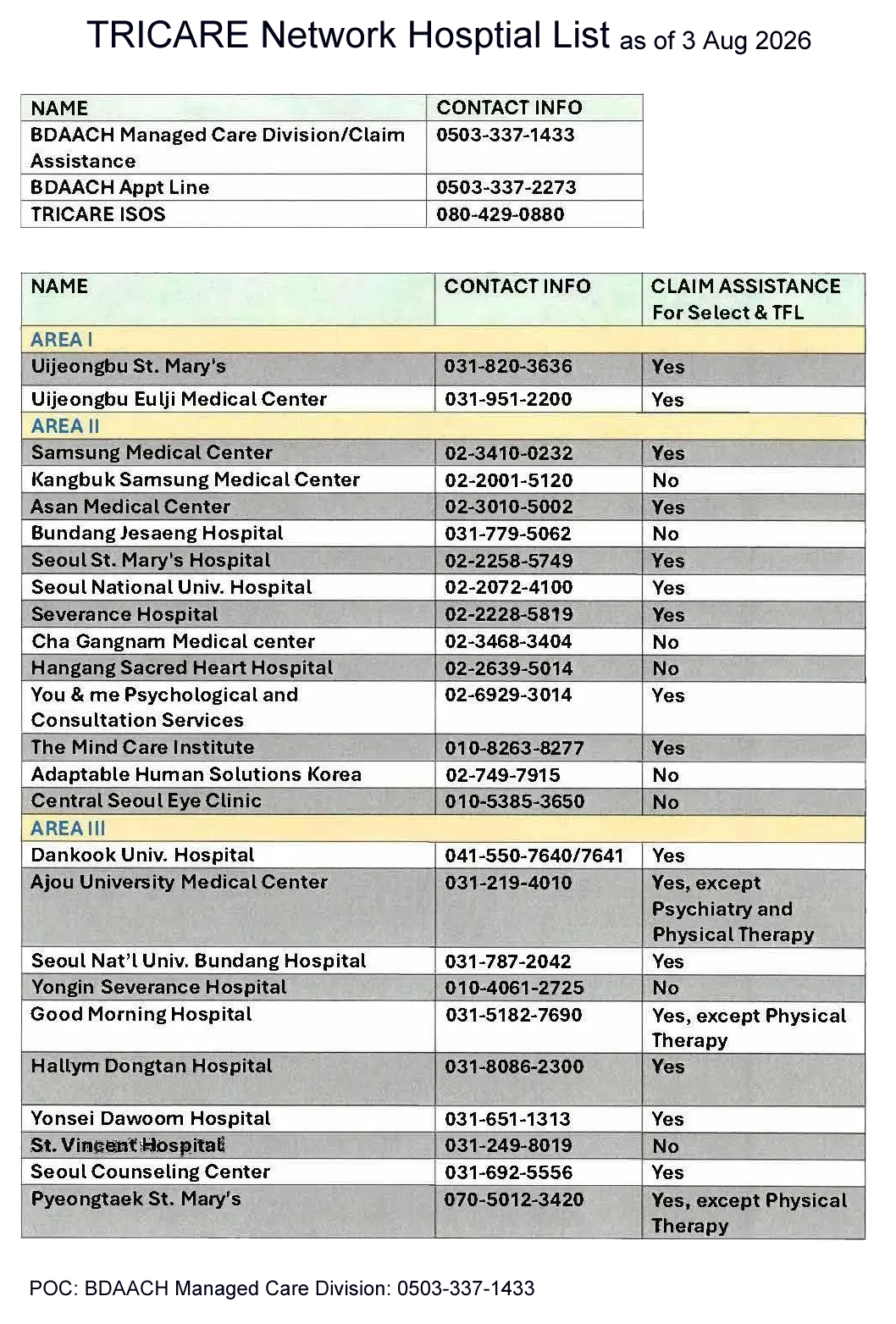
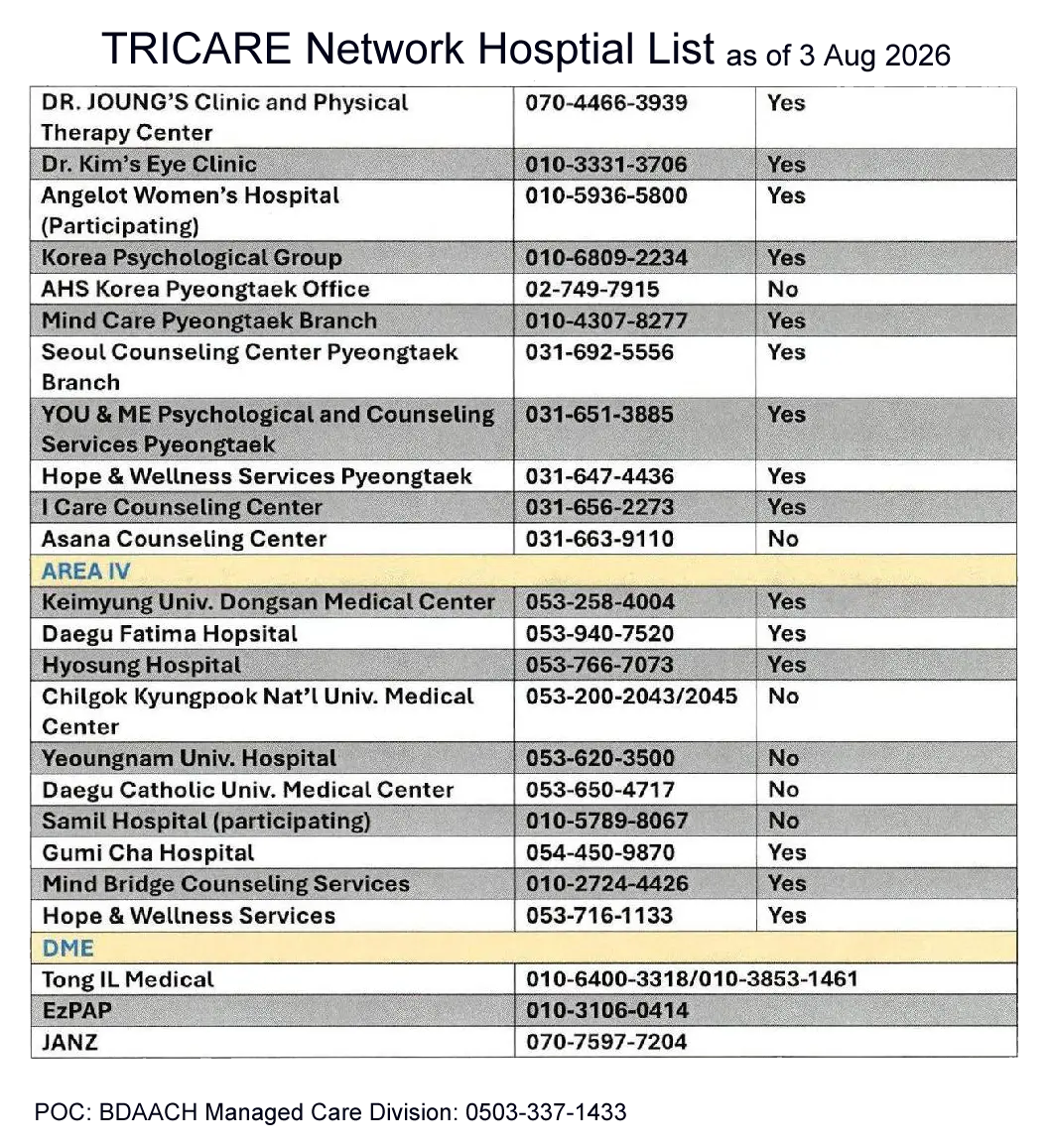
Money-saving tip: When calling internationally, use Skype or similar app on your smartphone or computer. With Skype, U.S. toll-free numbers are free and international numbers are just pennies per minute.