
Korea is not a Visa-free country. When you retire in Korea you no longer have SOFA status, an A-3 visa or the umbrella of protection it provides. Time to apply for a Korea Visa if you wish to remain here. Below are some basic guidelines about Visa's and URL links to official websites for their details. With so many different situations each of us can encounter, we do not list every Visa or every case for a Visa here.
It is important to keep in mind that as a retiree in Korea you are basically just another US citizen in Korea. Your military retiree status gives you nothing extra as an expat here. On-base you have privileges, but off-base, nothing special than any other American in Korea. USFK will do basically nothing to help you out of any jams you might find yourself in.
When visiting any immigration office, you must make a reservation/appointment, UNLESS you are 70 years old. Immigration offices do not require appointments when you reach 70, walk-in is fine. Visit the HiKorea website to make reservations https://www.hikorea.go.kr/resv/ResvIdntR.pt#this
Those on VISA other than A-3 SOFA visa, when you get the letter in the mail informing you your visa is going to expire, make your appointment and also TAKE that letter to the immigration office with your appointment. Doing so will waive you from filling out the forms at the appointment.
Some hire/use an immigration lawyer in Korea to fill out paperwork and forms for your signature. A Google search or asking friends are good ways to find them. A couple of websites that may help are:
https://www.expatkidskorea.com/listing/immigration-lawyers-in-korea
https://www.expatguidekorea.com/seoul/best-immigration-lawyers-korea
The Korean government requires an FBI Identity History Summary Check, i.e. background check for all new F-type visas. The FBI has implemented an option to electronically submit and receive responses for these background checks called Electronic Departmental Order (eDO). The eDO background check option is found on the FBI website at https://www.fbi.gov/services/cjis/identity-history-summary-checks and allows faster processing times of requests, which the FBI estimates to be 3-5 business days upon their receipt of your fingerprint card. Visit the https://www.edo.cjis.gov for details and How To Submit A Request. During the process you will need to:
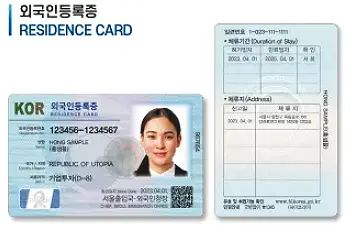
TIP: If you are a retiree or veteran living in Korea it is almost imperative to have a Residence Card, because just about everything you do in any official or government office requires one. The Residence Card is a Korean national identification card for foreigners, providing a form of ID and Korean ID Number. It is required for signing up for services like cell phone plans, internet, banking, and health insurance.
What we all knew as the Alien Registration Card (ARC) was changed to Registration Car in January of 2021 in response to criticism over the term “alien”. There is a good article at https://www.korvia.com/the-new-residence-card-in-south-korea-whats-changed-and-how-to-obtain-it/. If you have a current ARC card that is not expired, it is still good as-is! When you get it renewed you will get the updated Registration Card.
Again, Registration Cards are a must have for non-SOFA status personnel, but SOFA status folks with an A-3 visa are still highly encouraged to get one. It's pretty easy and painless.
This is an example of a Korea issued handicap parking permit. There are different variations. The Korean Handicap Parking Placard will expire on the same date as your Korean Registration Card. To renew your handicap parking placard at expiration, you will need to resubmit all the required paperwork again with your updated Korean Registration Card.
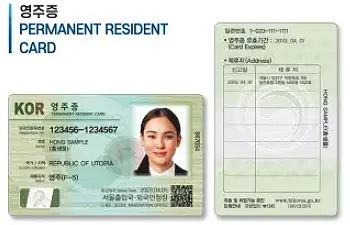
Issued to foreigners who hold permanent residency status, and it is valid for 10 years.
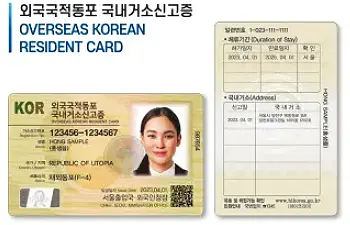
Issued to foreigners who are overseas Koreans with foreign nationality and have reported their place of residence in Korea.
- If you are retiring in Korea
- If If you intend to stay more than 90 days in Korea
- If you lost SOFA status, but will remain in Korea
Starting in January 2025, foreign national residents in South Korea can apply for digital ID cards through the Mobile IDentification App, available for both iPhone and Android devices. Foreign residents aged 14 and over who own a smartphone under their name can get the mobile ID card. The digital card carries the same legal validity as the physical card and can be used in places such as public institutions, hospitals and convenience stores to verify one’s identity. There are two ways one can apply this way: Visit immigration office or Tap IC chip-enabled ID card on smartphone. Read more at https://www.koreaherald.com/article/10389035
Download the application form on the Hi Korea official website at https://www.hikorea.go.kr/board/BoardApplicationListR.pt?page=1&locale=EN and go to an Immigration Office downtown in your area, but you must make a reservation online for your office visit. Go to the immigration homepage at https://hikorea.go.kr/resv/ResvIntroR.pt#this to Reserve a Visit (book a date and time). Apply at the Immigration Office in your residential area. Offices outside of your addressed area will not serve you.
NOTE: If you currently have an A3 SOFA Visa, you can apply at the Osan AMC Terminal Immigration window or at the USAG Humphreys SOFA Stamp Issuing office in Maude Hall (OneStop 2nd floor). No appointment needed to apply, but you must go in-person to the Immigration Office to pick up your card, which in the Osan area is the Pyeongtaek Immigration Office in Songtan. It's published name however is Suwon Immigration Office, Pyeongtaek Branch (directions using Waze).
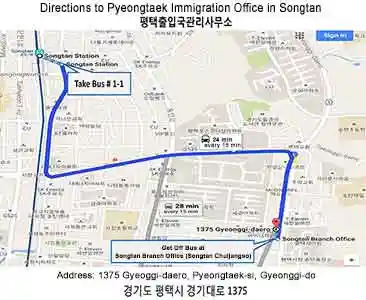
Mon-Fri 0900-1800
Closed Korean holidays
Walk-in's are accepted
Pyeongtaek Immigration Songtan Office
1375 Gyeoggi-daero
Pyeongtaek-si, Gyeonggi-do Korea
Across the street from the Old Songtan City Hall
Click here to open 2022 revision of the ARC Application Form
Click here to go to Hi Korea Forms page for ARC Application Form (called 'Integrated application form')
You do have the option to have your ARC card delivered to you via Korea Post mail, but make sure to ask the immigration agent about it. They do not automatically tell you about it, but if you ask then they will. You of course can also return to the immigration office and pick it up.
You must update your ARC card for two two primary reasons, and it must be doen within 14 days of the event to avoid huge financial penalties.
The card must be returned to the Immigration Office / immigration officer at the departure airport or port upon final departure. Failure to return will result in fine. For more information, please contact Immigration Call Center at 1345 (within Korea).
It has been asked before, so lets address this up front:
You cannot hold both any F Visa and an A-3 (International Agreement/SOFA) visa simultaneously in South Korea. South Korea’s immigration system only permits a foreign national to hold one active residential or status category on their passport at any given time. While I do have a specific weblink address this, the concept of holding only one single status is outlined in the Immigration Act guidelines under the "Permission for Change of Status of Residence" section on the HiKorea Application Guide.
1345 Immigration Hotline: In addition, Korea has a new website implemented in July 2026, the 1345 Immigration Hotline: If you need verbal confirmation of this law or require specific paperwork tailored to your dual passport/SOFA situation, you can call the Korea Immigration Service https://www.immigration.go.kr/immigration_eng/ directly at 1345.
NOTE: Current F-1 Visa holders are grandfathered as F-1 Visa's and do not convert to F-3 Visa's. They will continue to hold their F-1 Visa, and renewals will be as F-1 Visa's. However, new Visa applicants will get an F-3.
The F-2 visa is a "Resident" visa allowing long-term residency for various financial reasons, but also including being a spouse/child of a Korean national or F-5 visa holder.
Eligible Applicant Example(s)
The F-2 visa is a "Resident" visa allowing long-term residency for various financial reasons, but also including being a spouse/child of a Korean national or F-5 visa holder. F-2 visa holders can engage in various activities, including entry, employment, business, and study in Korea. After maintaining certain conditions (like investment for at least 5 years), F-2 visa holders can apply for F-5 (Permanent Resident) status.
Korea Visa Portal / Family Visitor - Dependent Family
https://www.visa.go.kr/
IMPORTANT NOTE: As of April 2025 you cannot apply for an F-3 Visa in-country! You apply for it while in the U.S., which means if you are in-country now, you need to leave and apply for the F-3 Visa from the U.S. Also, the applicant will be asked to provide financial documents to validate you have funds to sustain yourself in-country.
Who it’s for: Spouses and dependent children (under 19) of foreigners holding long-term visas such as the F-4 visa. This F-3 visa replaces the F-1 for first-time applicants i.e. if you are a retiree married to a Korean born US citizen, you will not get an F-1 any longer, you will get this F-3.
Work Restrictions: No. F-3 visa holders cannot work in Korea. To work, you must secure a separate work visa and change your status.
Duration & Validity: Tied directly to the primary visa holder’s contract and Alien Registration Card (ARC). If the primary visa holder leaves Korea, the F-3 visa expires. The normal expiration date of an F-3 Visa every 3 years, but there are exceptions that makes that date less.
Eligible Applicant Example(s)
A retiree living with a Korea born spouse, who has an F-4 Visa and is a US citizen, is eligible for a multiple-entry F-3 Visa, specially an F-1-9 (Spouse, minor children and parents of F-4 visa holder). F-1 visa holders cannot typically work. The period of stay is up to 2 years and can be extended. Learn more at https://kpmg.com/xx/en/our-insights/gms-flash-alert/flash-alert-2025-141.html
Korea Visa Portal / Overseas Korea
https://www.visa.go.kr/
Eligible Applicant Example(s)
Retiree spouses with Korean heritage, even if they are a U.S. Nationalized Korean, are eligible for an F-4 visa.
Eligible Applicant Example(s)
A multi-entry visa for foreigners with no connection to a Korean relative, but wish to stay in Korea long-term. If you leave Korea after obtaining an F-5 visa, you must return to Korea every 2 years in order to keep it active, You must renew the Visa every 10 years. An F-5 Visa holder may also work in Korea. This is a difficult Visa to get.
Requirements and How to Apply: https://www.visaskorea.com/f-5-permanent-residency-visa/
Composed by Tim Ryan
Tim Ryan wrote this and posted it in the RSO Korea Facebook group in late 2024. It has since helped about more than 15 people get the F-5-13 VISA. Tim is a retired Army guy with 22 years Army Infantry, and then another 22 as a DA Civilian Army Range Officer. He does not claim to be a legal or immigration expert by any means, he is just sharing what he has learned by going through the process of obtaining his F-5-13. The pension links provided are for military and civil service, but should give everyone a good idea of the processes:
If you are retired, 60+ and your pension(s) are twice the Korean Gross National Income (GNI) (around $36,624 x2 = $73,248 a year depending on exchange rate) [Social Security and disability counts] then you can get an F-5-13 VISA (equivalent to a green card in the US.). There are no other requirements to apply, you never have to renew it. (Fingerprint check every 10 years to prove it's you), it never expires and it qualifies you for Korean Health insurance at a reduced rate (maybe around $18.00 a month).
Depending on where you are staying, it can take 4-8 months for approval. You can stay in country until a decision is made. It is not a frequently used VISA, so a lot of Immigration Offices won't know about it initially. Usually, it requires a supervisor to step in. It's also not on the KIS website.
Retired active duty:
Retired Civil Service:
Everybody:
Just a note if you're not currently carrying a Korean Residence Card you won't be able to get a Resident card while you are waiting for the F-5-13 approval. If your wife is Korean, she can use her F4 to get you a temporary phone and she can open a Korean bank account.
FYI: Korea does NOT allow joint bank accounts. The way we "got around this":
- My wife opened a Korean account with her F-4.
- We have a NFCU account and take the money out of the NFCU every month and exchange it off post then deposit all of it into her Korean account, which feeds the autopayments for bills, etc.
- I have a separate Korean account with the same bank and her Korean account auto-deposits an amount into mine. I have a debit and credit card from my Korean account.
- I also have all of her account info, so if I need money or she's not available, I can see what's goin' on or transfer money online.
Hope this helps
Who it’s for: Foreign nationals legally married to a South Korean citizen.
Work Permissions: Unlimited. F-6 visa holders can engage in any legal employment, start a business, or work part-time without additional sponsorship or visa changes.
Duration & Validity: Grants residency based on the marital relationship. It requires periodic renewals but is independent of the Korean spouse's employment. If the
Link: Korea Visa Portal / Marriage / Immigrant https://www.visa.go.kr/
Eligible Applicant Example(s)
A retiree married to a Korea born spouse who is NOT a US citizen, is eligible for a multiple-entry F-6 Visa. F-6 Visa allows the Visa holder to work in the Republic of Korea for two years.
How to Apply, Korea Visa Portal: https://www.visa.go.kr/openPage.do?MENU_ID=10105
Korea Visa Portal ( Short Term Visit ) https://www.visa.go.kr/
Eligible Applicant Example(s)
A person who plans to stay for a short period of time on the purpose of visiting relatives, investing in public business, participating in a non-official sport games, attending events or meetings, performing cultural art, engaging in a training, taking lessons, attending a religious ceremony, collecting documents for academic research, or any other equivalent activities.
Tourists expected to stay of 90 days or less.
You must complete a Korea Electronic Travel Authorization (K-ETA) online either before you travel or at the airport when you arrive. Requires departure from Korea every 90 days to restart the 90 day clock. At the 90 day point, or prior, many individuals fly to Japan, Okinawa, Guam etc for the day and then return. Upon returning to Korea, the 90-day clock restarts, but requires another K-ETA.
For those retirees still working federal jobs here with SOFA Status
You must be a U.S. government employee to be eligible for an A-3 Visa i.e. Civil Service (GS/NAF/WG/GG etc), Invited Contractor with a form 700-19, AAFES, and also includes non full-time employees as NAF, Civil Service, and AAFES (but not Invited Contractors) that are less then 40 hours a week flex or intermittent time (usually 20-36 hours a week).
Common Question: I am currently under a A-3 visa with SOFA status, and even have a Korea Registration Card. I am about to terminate my government position here in Korea and prepare to move out of Korea. How long may I remain in Korea before I must leave the country?
Answer: You retain SOFA status under your A-3 Visa for 30 days after employment end date, at which point you must leave the country and return under another visa status. If returning as a tourist (C-3), then you must leave the country every 90 days. That 90 days does not begin immediately after losing A-3/SOFA status i.e. staying in Korea 30 days + 90 days consecutive after termination government employment. If you have a Korea Registration Card (called ARC previously), as your A-3 is expiring, you must update your ARC card visa status at an Immigration office. Your ARC card does not automatically extend that 30 day requirement and allow you to remain longer in Korea past the 30 days. Even if you re applying for an F-5 or F6 visa to remain, that new visa must be obtained within the 30 days.
You should get a "Advance Notice on Expiration of Stay" notice in the Korean mail from immigration about 90 days prior to visa expiration stating the visa is expiring. It says in both English and Korean that you can use the notice as proof of your place of residence. It also says to check the "Immigration/Stay Guide" or call 1345 to find out what documents you are required to submit when you come to your Visa appointment. One of them, maybe the only one (call and make sure) is the "extension of stay" form that is available at the immigration office.
You can also renew your visa (any visa except A-3) up to four months before it expires. If you go online to the Hi Korea website you can request a visa update online, get a discount for doing it online, and submit (upload) less paperwork. They ask for a copy of your lease, and if you have an F-1 or F-6 as a spouse of a Korean citizen or F-4 visa holder, they ask for your marriage certificate. Could take as little as 10 days. They will provide a downloadable letter saying the visa was updated that you either carry with you, or take into an immigration office later (no appointment usually needed for this) to update your Korea Residence card.
HINT: Anytime you go into an immigration office always bring every conceivable original document you can think of in case they ask for it. Online, if they want any additional documents they will ask and you simply upload them. Many say online is the fastest and easiest method.
Korea's Smart Entry Service (SES) is a state-of-the-art system. that registers passport information and biometric information. (fingerprint, face) in advance under the name of the Automated. Immigration System in Korea, and then uses it to conduct immigration inspection at the Smart Entry Service Gate at airports and sea ports and verify travelers. SES is available at many airports in Korea, including: Incheon Airport, Gimhae Airport, Gimpo Airport, Jeju Airport, Daegu Airport, Cheongju Airport
To learn about SES: Who can use it, How to register, etc, go to https://www.immigration.go.kr/immigration_eng/1859/subview.do
Recently, the Korean government has automatically added all ARC cards into the SES system. This means if you have an ARC card, you can use SES at the airports, BUT there is a catch you need to be aware of:
BLUF: While Status of Forces Agreement (SOFA) between the United States and the Republic of Korea (ROK) primarily governs the activities of active-duty and actively employed civilians and contractors in South Korea, it does provide some (minimal) framework for U.S. military retirees, particularly regarding their legal standing and residency. Retirees must still follow South Korean laws and regulations, and they will not enjoy the same immunities or privileges, but it is worth mentioning here in case a retiree is still working in Korea.
The SOFA is a legal framework that outlines the rights and responsibilities of U.S. personnel stationed in South Korea, including military personnel, civilian employees, and their dependents. This agreement covers a variety of aspects, such as the legal status of U.S. service members and their families, jurisdiction over criminal offenses, tax obligations, and other logistical matters while they are in South Korea. For U.S. military retirees, the SOFA primarily applies in terms of their legal status and their ability to reside or visit South Korea. However, retirees typically do not have the same status as active-duty personnel under the SOFA, as they are no longer part of the military command structure.
Here's a breakdown of the key aspects that apply to U.S. military retirees under the ROK-U.S. SOFA:
BLUF: Retirees in Korea under ANY Visa other than A-3 SOFA or C-3 Tourist cannot get hired as a GS, NAF, Contractor or any DOD employment.
For your spouse to apply for residency in the US, start by going to the U.S. Department of State FAQ page for DS-260 Immigrant Visa Electronic Application at https://travel.state.gov/content/travel/en/us-visas/visa-information-resources/forms/online-immigrant-visa-forms/ds-260-faqs.html